


I am not a climber, but I’ve always had a soft spot for mountaineering films and books. Books like Into Thin Air by Jon Krakauer and Touching the Void by Joe Simpson are amazing books.
Today, with social media being an important aspect of any professional climber’s needs, that means that most are accompanied by a camera person. Action cameras and drones mean that everyone can get stunning footage from their climbs — assuming you make room for all the batteries in your packs.
Three different films have been released recently that I found fascinating to one extent or another, and I’ve also watched a fourth related, but older film.
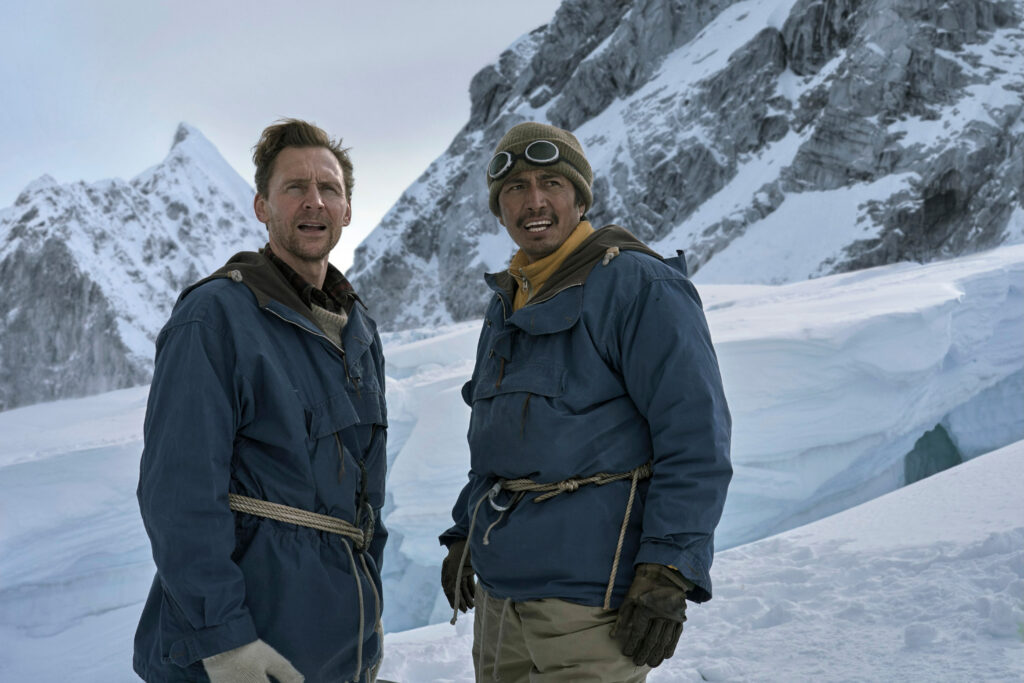
Tenzing is a big budget Apple TV film about Tenzing Norgay who, together with Edmund Hillary, was one of the first two climbers to ever summit Everest.
Genden Phuntsok plays Tenzing, an ambitious man from the Himalayas (where exactly he comes from seems to be uncertain), but in the film he’s from Tibet having moved with his family when his father loses his job and his income. The film has multiple flashback sequences showing Tenzing’s life including an early meeting with George Mallory (Johnny Flynn) who would die in his own attempt to summit Everest in 1924.
In 1953, having become an experienced climber, Tenzing joins John Hunt’s (Willem Defoe) expedition to summit the mountain. Nepal has given Britain the right to climb this year, with Tenzing having come close with the Swiss the year before. If the British miss this chance, the Nepalese won’t give them another go until 1956 by which time Hunt believe the mountain will have been climbed.
This is, of course, a film told from a Sherpa’s perspective, but even Tenzing is an outside early on because he comes from a different tribe. He has to fight to gain recognition.
In 1953 he is paired with the strong and silent Kiwi, Edmund Hillary (Tom Hiddleston) with who we know he will ulitmately summit. The film portrays the expedition with candour, and without additional peril. While there was a close call with Tenzing saving Hillary, the expedition mostly goes to plan, with the exception of taking much longer than hoped, and the initial two Brits that Hunt chooses to summit being unable to stand the high altitudes.
With filming in both Nepal and New Zealand, the film is beautiful to look at, and the performances are strong. This is Phuntsok’s film with Hiddleston being almost a supporting character. The film is directed by Jennifer Peedom who previously made a documentary feature called Sherpa about the group without whom few climbs in the high Himalayas would succeed.
Stefan Duscio’s cinematography is excellent, and the score from Rebekka Karijord fits well with the themes of the film, incorporating Nepali bells and the chanting of Ani Choying Drolma.
This isn’t a showy film, but it’s powerful nevertheless.
Also on Apple TV right now is The Last First: Winter K2. This documentary from Amir Bar-Lev tells the story of a 2021 attempt to be the first winter ascent of K2, the second largest mountain in the world. By early 2021, K2 was the only one of the 14 mountains that are 8,000m or higher that had not been climbed during the winter when the harsh weather makes the “death zone” even more deadly than at other times of the year.
We follow the Icelandic climber John Snorri Sigurjónsson and the Pakistani father and son Ali and Sajid Sadpara. Since K2 lies within Pakistan, the fact that a Pakistani team were attempting to summit the mountain takes on much more significance. There is national pride at stake.
But this team is not alone in attempting to summit the mountain. Nirmal Purja, or Nims, is the British-Nepali superstar climber who had climbed all 14 8,000m within a six month period, and was beloved in Nepal. He was well-supported, unlike the Icelandic-Pakistani group, and we see a tented city go up when his team arrive.
Beyond that, a commercial group, Seven Summit Treks had also arrived with plans to lead paying clients up to the top of K2. And there were others on the mountain too.
Things go wrong very quickly, with Nims and his team heading out before anyone else had realised, and claiming the first winter ascent. The Icelandic-Pakistani group are aggrieved that although everyone had laid out ropes on parts of the route, the Nepali team had headed out first without telling the others.
Then it gets worse, with a complete disaster at Camp 3 when the climbers do set off. They arrive in their tents on time, but the commercial group arrives very late at night, and it becomes apparent that there were not enough tents up there. People crashed inside the tiny tents meaning nobody could get sleep or even melt snow for water.
Nevertheless, the team with Ali Sadpara and a Chilean climber set off for the summit. Sajid had to turn around with a faulty oxygen regulator, but the others continued, despite not having recovered during the night sufficiently. Everyone else turned around and headed back down the mountain. But the three who’d left Camp 3 continued climbing. They were not seen again.
Sajid tried to stay at altitude to be of help to his missing father, but he had to come back down the mountain as the weather got worse.
There were two other deaths of climbers during that deadly season on K2.
The documentary is well told, and there is little sympathy for Seven Summit Treks who climbers claim were reckless in who they took to climb the mountain in such severe conditions and the appalling lack of coordination that led to there being no tents for their clients. But there are also feelings towards Nims and his Nepali team who had climbed without saying they were going. Nims’ showbusiness side clearly rubbed some up the wrong way, because his perfect English made him more famous than some of those who were climbing alongside of him.
Interestingly the film does not mention that Nims died earlier this year in Pakistan during a horrific avalanche that claimed all ten members of his team. While I appreciate that the film was probably locked earlier in the year, it felt like some kind of reference at the end might have been included.
Savage Mountain is a documentary on Sky Documentaries (and Now TV) following the Norwegian climber Kristin Harila as she tries to break the record for the fastest person to climb all 14 8,000m summits — all of which are within the Himalayas. She had previously tried to achieve this in 2022, but Covid restrictions prevented her from entering China and gaining the permits to climb two mountains that are either fully in Tibet or best ascended from there.
Harila explains that she wants to do this to show women are capable of these kinds of feats. Nims Purja holds the record, and she wants to lower it considerably. But funding for something like this is very tricky, and of course to achieve it, everything has to go right. You need weather windows at the right time, and you also need to avoid sickness.
So we see her scrabbling around to get funding, and during the course of the climb she does indeed get very ill at one point. She pushes on anyway. Interestingly, she is supported in her venture by the same Seven Summit Treks that had been criticised in The Last First.
Harila climbs the mountains with Tenjen Lama Sherpa and makes the strong case that all too often western climbers take the glory from locals, without who, they’d be unable to climb these mountains.
When she reaches K2, the team comes across a dying climber who is hanging from a rope. There is a great deal of criticism of both her and others, that they left the man to his death in their keenness to get up the mountain. This documentary certainly provides evidence that Harila did as much as she could. The man’s position was perilous, and it was not easy to save him.
But did people climb on? Absolutely. And not just from her team.
Sadly, we learn towards the end of the film that Tenjen died later that year in a separate climbing accident when he and an American were killed on Shishapangma in Tibet, one of the 14 peaks he’d already climbed that year with Harila.
The film also references the death of Nims earlier this year.
Having watched these three films, I realised that I hadn’t seen 14 Peaks: Nothing Is Impossible, the Netflix documentary from 2021 about Nims’ feat.
Like a lot of these mountaineering films, you feel that the production was put together after the event, utilising a combination of footage that the team took at the time (take plenty of GoPro batteries and memory cards if you’re doing one of these things!), archive footage, stock footage, and some specially shot drone/helicopter footage that almost certainly was shot months or years later.
Nims called his attempt “Project Possible.” But he had to mortgage his house in the UK at one point to fund his mission, although he did find commercial sponsors including watch company Bremont. He also took that shot of hundreds of people queuing to reach the summit of Everest.
14 peaks are a lot of peaks to show essentially the same thing — the preparation, climbing shots, summiting and so on. There is a degree of repetition. So we get background stories, such as that of his severely ill mother. It seems likely that gaining permission to climb Shishapangma in Tibet was the biggest difficulty.
Nims certainly is an interesting character. He was a Gurkha and served in the UK special forces. He had excellent English which probably helped him as he became more globally famous. And the film certainly makes a strong case for a globally famous Nepali climber achieving some of the same levels of fame as North American and European climbers.
It’s unquestionably very sad that someone like him died when he was so young. But death is far too frequent in these films. The “death zone” above 8,000m truly is that. Deadly. And it’s clear that skill isn’t enough — sometimes it’s just luck.
What do I take from all of this?
Climbers featured in these films are mostly a pretty selfish bunch — they take risks not only their own, but those of others. Because everything has been climbed, now climbers have to do things like race up or down mountains faster than before.
Social media and sponsorship is a massive part of climbing. It costs tens of thousands of dollars to lead these expeditions. Brands expect something from their sponsorships, and that inevitably leads to climbers taking bigger and greater risks.
I’m not sure what the end game is here? There doesn’t seem to be a lot of enjoyment coming from these activities. They’re a means to an end; a way to earn a living. For the Sherpa and those in the Himalayas, it’s literally a living. And that introduces its own challenges as the Nepali government wants to take more money for climbing permits each year.
Mountains are incredibly beautiful. Earlier this summer I was lucky enough to spend some time cycling in the Pyrenees. The mountains are spectacular. But they’re also deadly. I don’t personally feel the need to put myself at risk in the mountains. But I do love visiting and being there.
The Instagram nature of our world means, unfortunately, that a lot of people just want to “tick off” another thing. Get a photo. Get the kudos and move on. And indeed, unless you are personally wealthy, this is the only way you can even afford to this kind of thing.