
If there’s one story in the US media that is coming out of this World Cup, it’s that Fox and the Spanish language Telemundo are having an absolute field day with the enormous ratings they’re generating, even though all the host countries were out by the round of 16. More than 50m people watched USA v Belgium across both channels, with nearly 47m watching Mexico v England – the vast majority coming on Telemundo for that fixture.
When FIFA announced “hydration breaks”, Fox was quick to sell that time as advertising (unlike Telemundo, or ITV in the UK), and generate millions more in revenue.
It’s also important to understand that Fox got this World Cup at something of a bargain rate (NYT $). Essentially they’re paying less than $500m for the rights for a tournament in their own timezone because FIFA had previously given the 2022 World Cup to Qatar having sold TV rights to a summer tournament.
Handing the 2022 tournament to Qatar meant moving it to the winter, where it clashed with Fox’s existing programming, and notably the fantastically valuable – and expensive – NFL rights the company has. To avoid a lawsuit, FIFA just extended Fox’s deal at something of a cut-price rate, along with the deals it had with Telemundo and Canadian broadcasters.
The question now is who gets the 2030 rights and beyond? And how much are they worth?
I mention this, because CNBC is reporting that US streamers are thinking about the US rights being worth $1.5 – $2 billion for the 2030 and 2034 tournaments. That’s for each tournament – and more than 3-4x what Fox is currently paying, for games that will mostly not take place during US peak time periods.
Netflix, Disney and YouTube are all said to be interested in grabbing the rights, with English and Spanish-language rights being bundled together this time around.
And to be clear, these are US-only rights. FIFA has already sold rights in other territories. For example, the BBC and ITV already have 2030 rights in place. And additionally, many European countries, including the UK, have free-to-air requirements for the entire tournament. So it can’t be easily used to drive paid subscriptions via a single global streamer. In any case, sports rights are frequently more valuable when sold on a market-by-market basis. (I’m unconvinced that Discovery has gained true value from its Europe-wide Olympics deal).
Are the US-only rights really worth that amount of money?
The 2030 competition takes place mainly in Spain, Portugal and Morocco, with some extra games being played in Argentina, Paraguay and Uruguay in commemoration of the centenary of the competition.
While those South American games are only 1-2 hours ahead of the US EST (and 3-4 hours ahead of PST), that still means that the latest a game might air in the US is 8pm EST. And currently, those South American countries are only due to host a single game each.
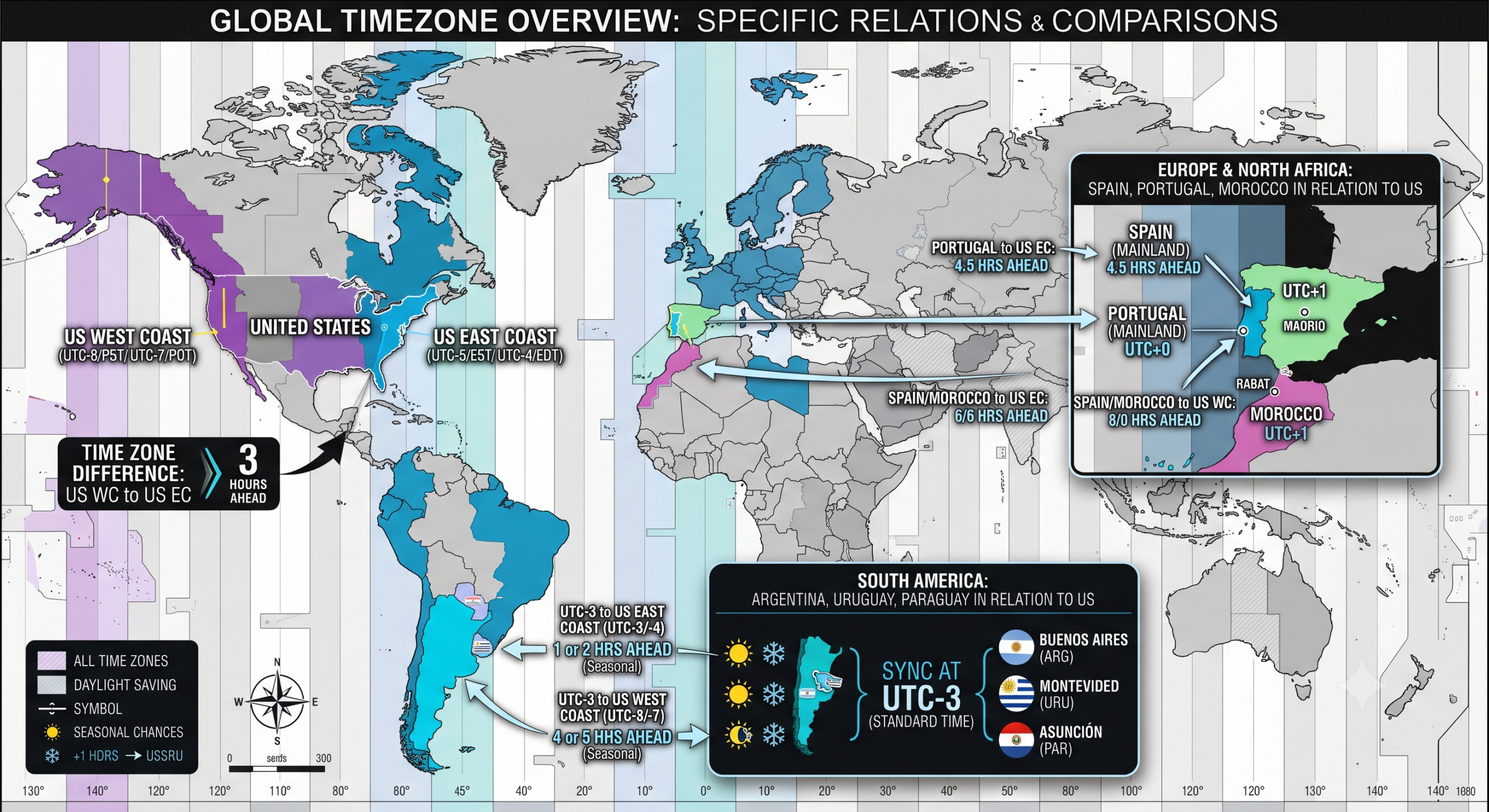
That said, FIFA is suddenly wondering if it can increase the number of qualifying nations from 48 this time round (already up from 32 in previous tournaments) to 64 next time. That might see more games in South America since the proposal comes from CONMEBOL the South American governing body.
But most of the knockout games would surely still take place in Spain, Portugal and Morocco who are the actual “host” countries. Again, a 9pm local time game in Portugal would air at 5pm EST in the US. That is as late as fixtures would be likely to go, with games kicking off earlier during the group stages.
Even worse, the 2034 rights have been awarded to Saudi Arabia, since Europe, Africa, South America, and North America had all recently “hosted”, the door was left wide open for the Kingdom. That makes some truly unfortunate times for matches in the US.

And indeed, since Qatar and Saudi Arabia are on the same Arabia Standard Time (AST), we can look to see when matches took place in the 2022 World Cup, and determine when they’d air in the US.

So the latest a match is likely to air in the US is 2:00pm EST. Not exactly peak viewing time for non-weekend days.
Set against this, the combined advertising revenue for the 2026 World Cup is said to be around $850m across Fox and Telemundo – double that of the previous best (actually Russia 2018 and not Qatar 2022).
That means that the World Cup 2026 is going to be insanely profitable for Fox and Telemundo this time around.
But the next two tournaments can’t surely even replicate the audiences of this one, never mind the advertising revenue? So can those $1.5-$2 billion costs be worth it?
FIFA will take the money of course. But it just does not add up for me.