
It has been ages since I wrote about what I’ve been reading, so here’s what I’ve read over the last couple of summer months.
Apple in China by Patrick McGee

This is a fascinating account of Apple’s history seen through the lens of its manufacturing, how over time that morphed into a growing dependence, and finally utter reliance on China as its scale grew – as did its profitability. Given the second Trump presidency has put pressure on Apple to bring manufacturing back to the US, you realise from this book, that this is simply not possible. The book obviously also charts the rise of Foxconn, and some similar contract manufacturers. But the supply chains and the flexibility that China offers are simply unparalleled in the world.
Even as Apple now tries to diversify its manufacturing bases to other countries like India, they don’t have the culture of people relocating across the country as China does. Many of those Foxconn employees have come from rural areas, work in the factories, and only return home for New Year. Although even then, as salaries increase, the work can be laborious and there can be very high turnovers. The only thing we don’t really get into here, is how much automation is changing manufacturing processes – although we do learn that China has vastly more robots than anywhere else in the world.
What also becomes clear is that Apple hasn’t just paid Foxconn to build its products, it’s carefully taught them how to do it, and often purchased the machinery and equipment that allows them to build and manufacture parts. And that goes further down the supply chain as Apple creates a new previously unseen design, it has to work with suppliers to build the parts in the right way so that they’ll work properly when they reach final assembly.
But this also creates a massive risk for Apple too. Regardless of the political situation in the US right now, they are also essentially beholden on China to manufacture at scale with the supply chains in place. And all the while, they’ve been teaching generations of Chinese engineers how to make beautiful smartphones. So it’s no surprise that high-end Chinese brands are making some incredible devices that even surpass Apple.
It’s not all about the business for Apple; it’s also about the politics. And McGee’s book makes clear how naïve Apple was for a long period, not really understanding the realities of operating in the country. A section dealing with the opening of the first Apple Stores in the country is fascinating, with “Yellow Cows” – essentially, organised gangs – having hundreds of people queue up to buy iPhones for the sole purpose of selling them on at a profit beyond the confines of Beijing and Shanghai. Apple’s frustrating policy of pairing specific parts with its devices and making you jump through hurdles when a part is replaced to get the new part paired properly, seems in part due to some scams that were being run at scale in China with fake or partially fake iPhones being brought in for replacement at official Apple Stores.
Overall, an absolutely fascinating insight into Apple’s recent history, and touching on what it really means to manufacture at scale.
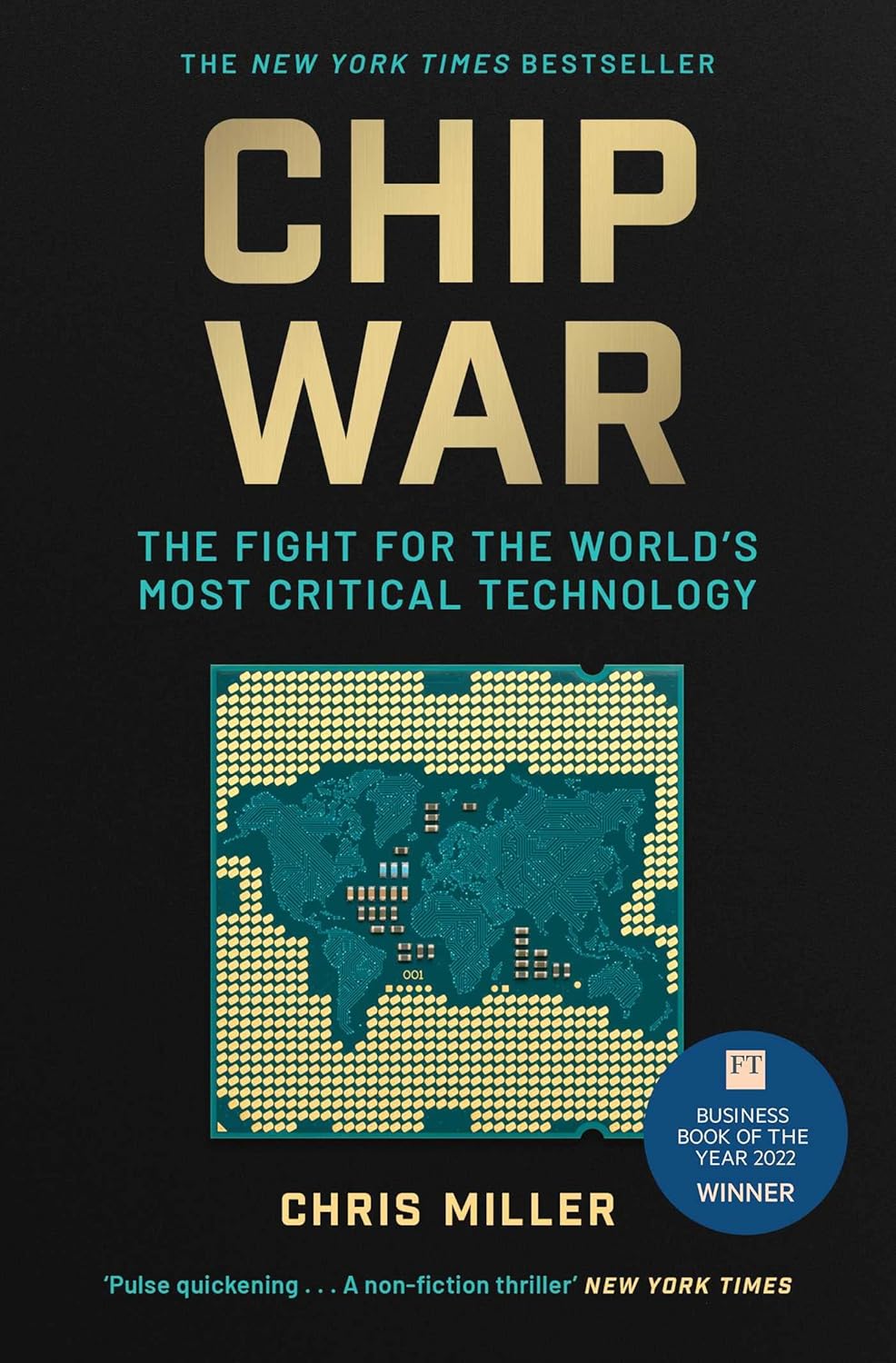
Off the back of reading Apple in China, I remembered that although I’d bought it, I’d never got around to reading Chip War. This essentially tells the story of the silicon chip from its beginnings, right through until the modern day (well, the book was published in 2022). At a time when both the US Government and Nvidia are taking stakes in Intel, this is as relevant as ever.
The book takes a long look at the history of silicon chip manufacture and the highs and lows of various companies along the way. What quickly becomes obvious is the lack of leadership in Intel who for so long were so dominant in the industry, that they failed to adapt. Today there is one company with one facility, TSMC, who leads much of the most important chip production in the world. They make all Apple’s silicon, and they do the same for Nvidia and AMD.
The book also makes clear the industrial processes and companies within the supply chain that are critical to any chip manufacturer. For example, there is a single Dutch company that is able to make Extreme Ultra Violet Lithography machines that are critical for producing chips. At a time when America is finally waking up to the political ramifications of losing its lead, this book explains how it’s just not that simple saying you’ll onshore chip production.
TSMC is critical to Taiwan’s exports and of course it sits in a politically precarious position. It also sits along an earthquake fault line.
This book is highly recommended to anyone interested in the most critical components in the world today – with those same chips powering all the AI advances we’re now seeing.
The Seventh Floor by David McCloskey

The seventh floor of the title refers to the top floor of the CIA’s Langley building where the executive suite is based, and this is the third of his spy thrillers, all largely set in a very real and very contemporary world, and featuring a set of characters who live within his same fictional universe.
In this book we return to Artemis Proctor, and her search for a missing agent who has disappeared during an operation in Singapore. In the meantime, the failure of this mission has led to Proctor being demoted as the CIA attempts ease her out.
I love McCloskey’s books, and this is as good as his previous ones, with a very real-feeling Agency watching the pennies regardless of the bigger picture, and you can tell that McCloskey has the inside knowledge as a former agent himself, to give a sense of credibility to procedings.

Another thriller, is The Peak, which explores espionage between Australia and China. Charles Westcott works for “The Party” in the Australian government, where he’s a bit of a behind the scenes fixer. He knows journalists and can use a lot of dirty tricks to get his way if need be. He works for his old school friend Sebastian Adler, except they’re not really that close. We learn how starting from their private schooling when they’d been outsiders together, the pair had an on and off friendship.
Now, something shocking has happened, and Westcott has to get to the bottom of it. It seems to involve and old flame of Adler’s and the cause of some of the frosty relationship between the pair. Suddenly, it seems like Westcott is being implicated in something he doesn’t understand in the claustrophobic government world of Canberra. Meanwhile wider events are taking place across Australia. Can they be related?
Guthrie tells a taut story, much of it told in flashback and also in part, epistolary. It opens up the Australasian world of espionage and in particular references lots of real life events, with large parts of the story beginning around the handover of Hong Kong by the British to China in 1997.
Overall, this is quite a page-turner.

I picked this up after a rave review in the FT, and I’m glad that I did. It’s basically the last 30 years of Croatian history told through the lens of a crime novel.
An 18 year Silva goes missing one evening, and a search is launched. But she isn’t found. Her family begins to fall apart, and her brother won’t let go and will continue the search. A policeman is handed the case, and in some ways, he never lets go either.
The book jumps forward in time every so often as some new piece of evidence is revealed, or some clue is followed up. But the disappearance is always there, and it has consequences not just for the family but further afield too.
Meanwhile, in the background there is war, then there is peace; there are property developers and there are people with shady pasts reinventing themselves.
This is a very readable book, and one where you come away having learnt so much without even realising it.

This was the winner of the 2025 Arthur C Clarke award for science fiction, and it’s set in a world where personalised sex robots exist. In essence, she is there to serve at the whims of her owner Doug, and to begin with, things go well. Annie has been built to “enjoy” serving at his pleasure. But Annie is different to other robots, and she has a form of AI that is “autodidactic” and that lets her learn and “think” to an extent.
All does not go well, and Doug begins to notice that she isn’t quite the subservient creation he was promised. Despite costing a lot, he begins to treat her poorly – horribly indeed. And he thinks nothing of it.
He’s also in a world where owning such robots isn’t the social norm. So while Annie is essentially his “girlfriend”, he won’t be seen with her in public at first, and definitely doesn’t want to let his friends know who she is.
This is, in many ways, quite a disturbing tale. It’s well told and explores its world well. But it’s not completely knew. The TV series Humans, the film Ex Machina and any number of other low-rent movies you find on Prime Video, have explored this area as well (It’s curious that in nearly all instances, the robot is “female” and rarely, if ever, “male”). But there as a driving narrative, and I was keen to see where this ended up.
The In Crowd by Charlotte Vassell

For something a little lighter, The In Crowd is something of a romp. DI Caius Beauchamp is something of an unusual detective coming to us at a time when he’s got potential murders to solve, but is also entering the world of dating. He meets Callie at a drunken performance of a play when both are there supporting friends in the cast.
There’s also a cold case to be solved, and things just have a way of being connected.
The delight of this book is undoubtedly the characters. Everyone feels real, and just a little off-kilter, not always behaving in the most obvious manner and there are laugh out loud funny moments.
This is actually the second book of a series, and I now need to go back to the first book, The Other Half, before I continue, as there is also an over-arching story being threaded through here.

Carl Hiaasen really doesn’t disappoint, and here’s another in his impressive canon of mad tales set in Florida.
The twin protagonists of Fever Beach are Twilly, an inexplicably wealthy man who makes it his life’s work to ruin other people’s lives if they mess up things like the environment, and Viva, a women who has had the misfortune to move in with Dale.
Dale is the founder of a new right wing hate group – “Strokers for Liberty” – having been thrown out of other groups like the Proud Boys. His methods make little to no sense, and his lack of spelling and basic grammar mean that most of his messaging fails to hit the mark. But there is some money being funnelled towards Dale and his chums, and where that money is coming from is interesting.
This is a timely, funny and at times outrageous look at some of the low life denizens of South Florida. Hiaasen has a glorious turn of phrase, and there’s a direct link between him and some of Elmore Leonard’s crime novels, where stupidity of those involved never gets in the way of their self-belief.
Hiaasen is on top form here.
A Beginners’ Guide to Breaking and Entering by Andrew Hunter Murray

This was shortlisted for the Bollinger Everyman Wodehouse Prize for comic fiction, and I was looking for something to listen to over a series of long car journeys. It didn’t disappoint!
Al is an “interloper” – someone who breaks into otherwise empty (but not necessarily unoccupied) homes, lives there while the owners are away, and then having cleaned up after himself, sneaks away to the next place.
He lives a lonely existence doing this until one day he runs into a small group of others who seem to be doing the same thing. But when they choose one particular country house to stay in, having done all their due diligence to ensure that the house is empty, they are shocked to find the owner in residence. They are even more shocked, when that owner is murdered on his doorstep, and they’re now the prime suspects.
What follows is quite a romp across London, the south-east, and sometimes further afield. Al isn’t sure who to trust, and he can’t help but tell lies about himself too. Meanwhile the plot pulls in lots of threads of real life scandals from poor doors, to lapse company registrations, and the rules surrounding corporations buying up homes. A lot of this no doubt comes from one of Hunter Murray’s day jobs working at Private Eye.
This is a witty and fun novel. At times, the plot is slightly preposterous, but you get carried along with it because you enjoy spending time with the characters. I’m hoping for the start of a series.

Goodness – US publishers do like to have a very expositional sub-title on their books don’t they?
When I first heard about this book, I did wonder why the story was only coming out now, after Biden had stepped down and after Trump had won last year’s election. If there was a big secret, why did it not come out earlier?
In this telling, Tapper and Thompson say that it was only after Biden had finally stepped aside, that their various sources came through to furnish them with the horrific truth of how steep Biden’s decline had actually been.
This is the story of how a small number of those close to Biden managed to keep his decline a secret for so long. It quickly becomes clear that Biden needed more and more time away from the pressures of being president, and like many elderly, was only good for a few hours a day.
It wasn’t as though much of this was that hidden, but whether the right questions were being asked is another thing.
In most respects, this all hindsight. And yet today we have another aging president as well. Are the right questions still really being asked?
The Accidental Tour-ist by Ned Boulting
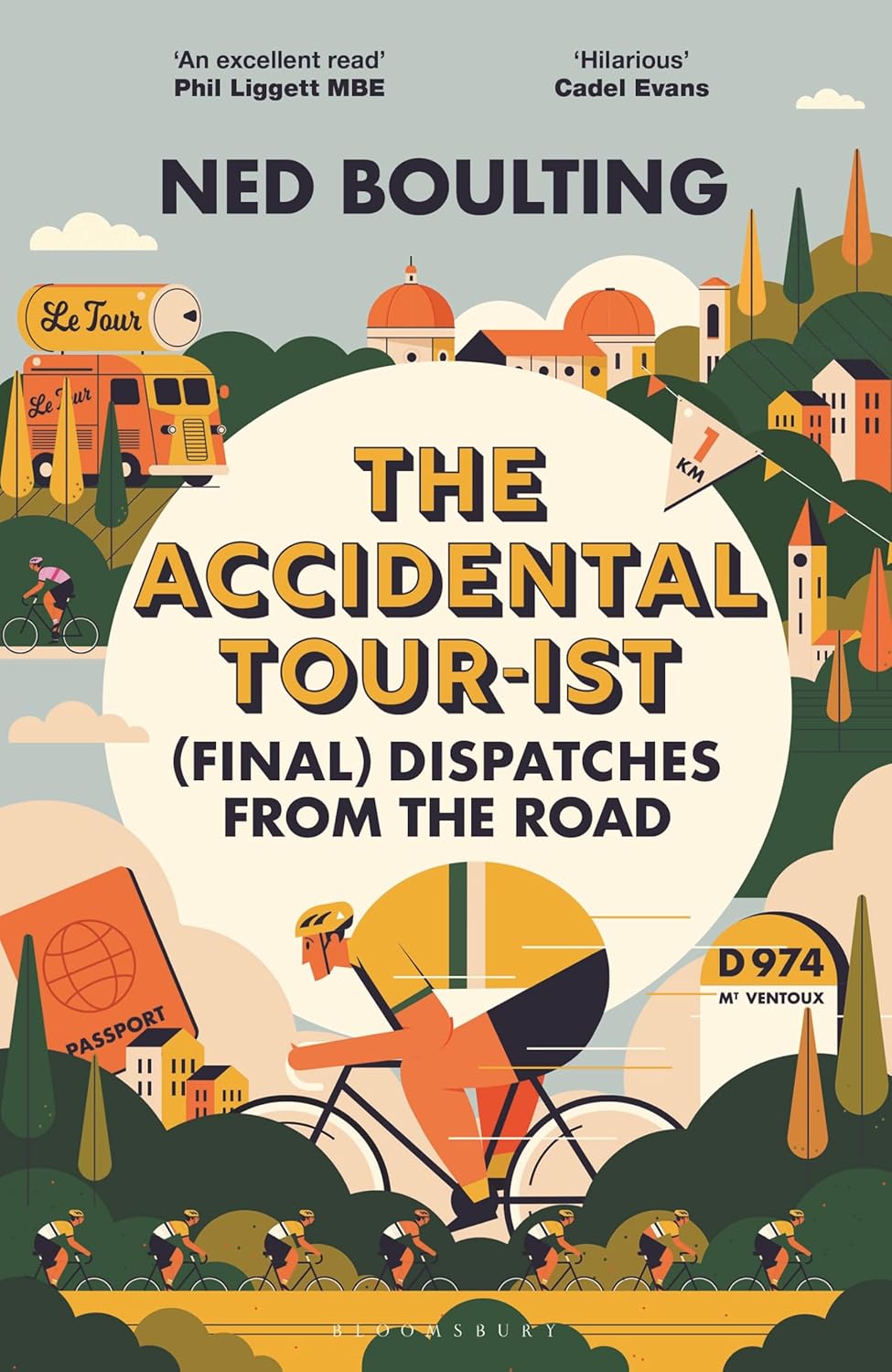
This summer saw the final outing of the Tour de France on free to air TV. Since Channel 4 first started broadcasting highlights, the Tour has been a fixture on mainstream British screens. It transferred across to ITV and ITV4 with largely the same production team, and we would get free live coverage along with an essential nightly highlights programme for those not able to spend hours of a weekday watching a bike race that doubled as an advertorial for French tourism.
But following the end of this year’s Tour, all the rights are now owned by Warner Brothers Discovery’s TNT Sports. And while they do a good job, they’re behind a paywall. Yes, there will probably be a nightly highlights package on the little watched free-to-air Quest, but it’s not the same.
The latest book from Boulting is in many ways his goodbye to that ITV (and Channel 4) coverage. It’s a behind the scenes look at life on the road as a cycling commentator and what that means. Indeed, one of the things that’s being lost is the on-the-spot commentator. TNT seem to prefer having their commentators work from home or Paris rather than on the road. It’s cheaper of course.
This is a light and breezy read, with lots of tales, dispatches and side quests. But it’s fun, and was good to read as an accompaniment to this year’s Tour.
Comments
One response to “Summer Reading”
Pretty! This has been a really wonderful post. Many thanks for providing these details.